Sunday, October 21, 2007

The Address Archive: Locust Mount

One of the assignments for digital history last week was to create a proposal for a digital archive meant to collect experiences. In response, I propose a website - Address Archive - which acts as an archive for collective experiences surrounding an address. Following the basic format of the 'History of Your House' database found in the City of Toronto Archives, Address Archive would go further, allowing individuals to upload photographs, written memories, and any other location-relevant material focused around a specific address. The Address Archive site would also be searchable, allowing visitors to enter an address and view all previously uploaded information regarding that location. Historic homes would especially benefit from such an archive since their experiences often predate recent memory. Take the case of Locust Mount:

At London's 661 Talbot Street, sits Locust Mount. This landmark home was build in 1858 by former London mayor Elijah Leonard. Leonard can be described as one of the city's founders, setting up a foundry in 1838 and playing an integral role in bringing the railroad to the city. Also a founder of the Huron and Erie Savings and Loan Co. (which later became Canada Trust), Leonard acted as a senator until his death in 1890. After being vacated by the Leonard family, Locust Mount experienced a number of reinventions; a private girl's school, condominiums, and most recently a fraternity, have all called 661 Talbot Street home. A devastating fire in 2000 left the house vacated and open to the elements causing rapid deterioration. Since 2001, Locust Mount has been threatened with demolition by its owner, Drewlo Holdings, who would like to build condominiums in its place (though it seems this fate may now be avoided).

If in the future Locust Mount is restored, photographs and possible original blueprints - which could be found in the Address Archive - would prove an invaluable source for renovators. If perhaps, more realistically, the house is either demolished or altered beyond recognition, archival memories of the once grand home would become a much cherished source, commemorating a vanished landmark.

No matter how visitors and contributors plan to use it, I believe the Address Archive would be a fascinating source for both historians and the broader community.

Images From:
1 - Urban Exploration London. "Locust Mount." http://uel.minimanga.com/locustm/index.html
2 - London Fire Services. "London Fire Services Action Shots."http://www.fire.londo%20n.ca/Action_Shots.htm

Friday, September 28, 2007

Moore House

For the last few weeks I've been following the potential fate of Sparta's 'Moore House' with some trepidation. The 183 year-old home (which predates Eldon House's construction by a decade) is presently facing demolition due to the new property owner's decision to build on the site. The house was built completely from local materials and is considered one of the earliest remaining brick homes in Southwestern Ontario. The builder of the home, John Moore, was a Quaker whose father, a United Empire Loyalist, settled in the area after the American Revolutionary War.

It should come as no surprise to those who know me that I want this house saved. After the Central Elgin council voted 4-3 against protecting the home under Ontario's heritage law - despite Central Elgin's heritage advisory committee's plea for protection - I had resigned myself to the fact that Moore House would soon disappear, like so many of its predecessors, without so much as a commemorative plaque. It seems, however; that I underestimated the public's interest in our region's heritage.

In a letter addressed to Central Elgin's council from Colin Read (former president of the Ontario Historical Society), Read states: "keeping the best structures of the past for the socialization and edification of present and future generations pays large dividends in the form of tourism and, even more importantly, in an enhanced sense of community. This vital lesson is too easily missed by many in these largely ahistorical times." A similar sentiment was expressed in a letter to the editor by Joseph O'Neil, Chair of London's Advisory Committee on Heritage, on September 25th 2007: "The Moore House in Sparta has much deeper significance than just it’s age...Why such history is never taught in our local schools is beyond me, but it is an obvious reason why we have to fight so hard to preserve one of the few remaining links to a magnificent past." These letters were followed by dozens of others from both local and provincial heritage organizations and - in what seems too often a very rare turn of events - actually seem to have had an impact.

On Saturday Sept 22nd 2007, Ontario Culture Minister Caroline Di Cocco issued a stop order on the demolition of Moore House. Though the future of the house remains uncertain (a stop order only prevents demolition for 60 days while the property's historical significance is further reviewed), it is sites such as this which fostered my initial interest in history. Even the temporary protection of Moore House gives me hope for the future of other heritage properties and helps to remind me why making history relevant to non-academic audiences is a noble pursuit.

Image from:

Simunac, Daniela. "Council opts against protection for 183-year-old Moore house." lfpress.com. September 19, 2007. http://lfpress.ca/cgi-bin/publish.cgi?x=articles&p=197395&s=politics (accessed September 28, 2007).

Monday, September 10, 2007

Current Counterfeits?

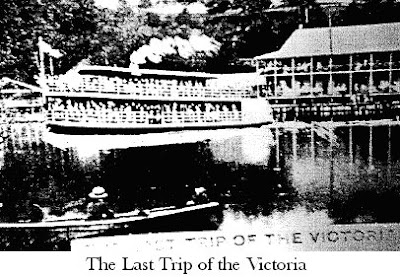
Many of the assigned readings this week dealt with the lack of credibility which tends to plague online history sources. The issue of source legitimacy is perhaps a more discussed issue in recent decades; however, I would argue it is one that has been of primary concern to historians for centuries. Cohen and Rosenzweig's assertion that "Fake photographs long predate the web", reminded me of an image I've come across in a number of local history books. A plaque in London's Greenway Park commemorates the 1881 sinking of the ship "Victoria" which - primarily due to cumbersome clothing and the general population's inability to swim - resulted in the loss of approximately 182 lives. The event garnered international attention and it was Mr. John Barron's photo, romantically titled "The Last Trip of the Victoria", which gained the most significant circulation in papers.

According to Ken McTaggart's work, "London's Darkest Hours", the image is not what it appears to be. It seems that on May 24th, the day of the disaster, Mr. Barron had forgotten his camera and therefore simply combined two previously developed photos, one of the Victoria and the other of Ward's Hotel in Springbank Park, to create a new image. McTaggart's careful examination of the composite image unearthed numerous errors (including painted-in smoke, an impossible bow wave, and the lack of a captain at the wheel) which expose the previously famous photograph as a forgery. This photo was from 1881! Though identifying a forgery was perhaps more simple in this case due to the archaic technology used to meld the two photos, it would have taken a significant amount of time, sifting through various non-digitized archives to find the original sources.

With the sheer amount of information now readily available to historians on the web, authenticity is of course going to be an area of concern but then again, it always has been. Perhaps Daniel Cohen's discussion of Blogging sums up my feelings about digital sources best: "Blogs are just like other forms of writing, such as books, in that there's a whole lot of trash out there - and some gems worth reading."

images:
Ken McTaggart, London's Darkest Hours, ed. Debra Rogers (London, ON: Ken D McTaggart, 1999), 40 - 41.

Tuesday, September 4, 2007

Blog Title

"There should be no hesitation ever about giving anyone a book to enjoy, at any age. There should be no hesitation about teaching future teachers with books they will enjoy. No harm's done to history by making it something someone would want to read."
- David McCullough, 2003