
That's it. I'm moving to Kingston.

 Ok, so a few weeks ago in Digital History we learned about mashups. Basically, these are web applications which combine data from more than one source into a single tool. There were a number of readings which discussed the potential uses for such applications in the humanities and I thought I had come up with one which would be really interesting. I was halfway through writing a blog on the topic when I realised it already existed.
 In digital history last term we were introduced to a program called Google SketchUp. Basically software which allows you to create and modify 3D models, the program's motto "SketchUp is 3D for everyone" certainly proves true. Not only is it a completely free program to download (in its basic form), but the tools are relatively intuitive. Within a few minutes of hesitant exploration, I was able to create some pretty cool models. Though I've already found a number of appropraite uses for the program, it is in a project for Public History that I believe I've reached my SketchUp potential.
 From a model of the property's first home, a log cabin (the foundation of which remains under the present library), right up to the Eldon House's present appearance, SketchUp has allowed me to combine two of my favourite things; history and architecture. Since the teaching modules we're creating will be used primarily with students from grades one to eight, perhaps these models can cause a moment's consideration of the physical home itself in a new generation. Though I still believe (as I argued in my last post) that computer models will always be a poor replacement for authentic historic homes, maybe they can help to reach a new audience. Just as genres of history which I previously ignored managed to hold my attention at the War Museum due to their innovative display methods, I hope that by utilizing interactive SMART Board technology in conjunction with a program like Google's SketchUp an appreciation and awareness can be created for London's architectural heritage.
 One of my Christmas gifts this year was the book ‘How Buildings Learn: What Happens After They’re Built’ by Stewart Brand. Based on the belief that buildings need to be examined not only in terms of space but also time, Brand suggests that buildings have the ability to adapt to changing circumstances when appropriately reshaped by their occupants. Though I’ve only started reading what promises to be a very fascinating book, a paragraph in the opening chapter caught my attention.
 I know what you all think this is going to be about - but it's not. Last week, I finally got the chance to go to Ottawa's War Museum with my boyfriend. There certainly was a controversy brewing, but it had little to do with strategic bombing campaigns. This disagreement simply centered around the limited amount of time we were able to spend in the Museum and the very different interests held by my companion and I.
 There were a number of exhibits at the Museum that I could have spent hours looking at. War Brides: Portraits of an Era - showcasing paintings, photos, and the stories of a number of the 44,000 women who came to Canada at the end of the Second World War as brides - was a beautifully moving exhibit. Stitches in Time - which consisted of 15 quilted artworks interpreting the Second World War experiences of women workers - was not only fascinating due to its medium but was also done by Johnnene Maddison, a London, Ontario artist. My personal favourite, the rebuilt 1950s pre-fab kitchen complete with linoleum flooring, was the closest I'll ever get to my dream doll-house. My boyfriend's tastes were certainly concentrated in different areas. The guns/swords, machinery, and medals - centering around an obsession with finding all the Victoria Crosses in the Museum - were much more to his taste. Besides Hitler's car, it seemed that we didn't share any interests. However, there was one area where we came together.
 One of the War Museum's greatest strengths is the interactive elements present in a number of its exhibits. Despite the varying content of the material, the inclusion of buttons, switches, telephones, and touch-screens, are all almost impossible to resist for any visitor. From the chin-up bar (where the voice of a very angry french drill Sargent nearly gave me a heart attack) to the Cold War command centre (where it was up to me to predict the outcome of a nuclear war) various interactive elements forced both my companion and I to explore realms of history that we would otherwise have avoided. The potential for interactive technology to draw visitors to unfamiliar or previously ignored historical genres should be of significant interest to practitioners of Public History. Now if they'd just take down that "please don't climb" sign on Hitler's car...
 I woke up this morning pretty grumpy. I hadn't slept well and I was thinking of all the things I needed to cover with the students in my tutorial today. Little did I know, my day was about to get significantly worse. Stumbling up the stairs on my way to the shower, I was quickly intercepted by my mother. "Gracie" she said, "There's been another fire at Locust Mount. I wanted to tell you before someone at school did."
 The fire this weekend did a huge amount of damage. Started by an open-flame of some kind - most likely caused by one of the homeless individuals who have recently been calling the mansion home - the already damaged house may now be considered beyond repair. A house that was already on the brink has now been pushed passed it. My feelings about the whole situation are perhaps best summed up by what was described as a "heartbroken" Counsellor, Judy Bryant, "[Locust Mount] was a very important piece of the soul of this city."
 I have a secret; a part of me hates Public History, a lot!
 At London's 661 Talbot Street, sits Locust Mount. This landmark home was build in 1858 by former London mayor Elijah Leonard. Leonard can be described as one of the city's founders, setting up a foundry in 1838 and playing an integral role in bringing the railroad to the city. Also a founder of the Huron and Erie Savings and Loan Co. (which later became Canada Trust), Leonard acted as a senator until his death in 1890. After being vacated by the Leonard family, Locust Mount experienced a number of reinventions; a private girl's school, condominiums, and most recently a fraternity, have all called 661 Talbot Street home. A devastating fire in 2000 left the house vacated and open to the elements causing rapid deterioration. Since 2001, Locust Mount has been threatened with demolition by its owner, Dre
 wlo Holdings, who would like to build condominiums in its place (though it seems this fate may now be avoided).
 For the last few weeks I've been following the potential fate of Sparta's 'Moore House' with some trepidation. The 183 year-old home (which predates Eldon House's construction by a decade) is presently facing demolition due to the new property owner's decision to build on the site. The house was built completely from local materials and is considered one of the earliest remaining brick homes in Southwestern Ontario. The builder of the home, John Moore, was a Quaker whose father, a United Empire Loyalist, settled in the area after the American Revolutionary War.
On Saturday Sept 22nd 2007, Ontario Culture Minister Caroline Di Cocco issued a stop order on the demolition of Moore House. Though the future of the house remains uncertain (a stop order only prevents demolition for 60 days while the property's historical significance is further reviewed), it is sites such as this which fostered my initial interest in history. Even the temporary protection of Moore House gives me hope for the future of other heritage properties and helps to remind me why making history relevant to non-academic audiences is a noble pursuit.
Image from:
Simunac, Daniela. "Council opts against protection for 183-year-old Moore house." lfpress.com. September 19, 2007. http://lfpress.ca/cgi-bin/publish.cgi?x=articles&p=197395&s=politics (accessed September 28, 2007).
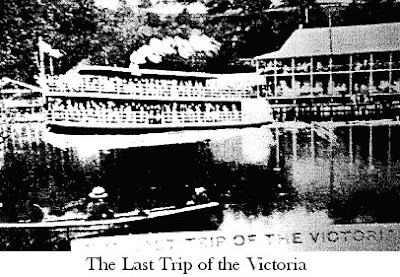 According to Ken McTaggart's work, "London's Darkest Hours", the image is not what it appears to be. It seems that on May 24th, the day of the disaster, Mr. Barron had forgotten his camera and therefore simply combined two previously developed photos, one of the Victoria and the other of Ward's Hotel in Springbank Park, to create a new image. McTaggart's careful examination of the composite image unearthed numerous errors (including painted-in smoke, an impossible bow wave, and the lack of a captain at the wheel) which expose the previously famous photograph as a forgery. This photo was from 1881! Though identifying a forgery was perhaps more simple in this case due to the archaic technology used to meld the two photos, it would have taken a significant amount of time, sifting through various non-digitized archives to find the original sources.
 With the sheer amount of information now readily available to historians on the web, authenticity is of course going to be an area of concern but then again, it always has been. Perhaps Daniel Cohen's discussion of Blogging sums up my feelings about digital sources best: "Blogs are just like other forms of writing, such as books, in that there's a whole lot of trash out there - and some gems worth reading."
images:
Ken McTaggart, London's Darkest Hours, ed. Debra Rogers (London, ON: Ken D McTaggart, 1999), 40 - 41.


